
RT4AE01 RT88H01 FAQ
I am looking at wireless communication modules and have a few questions about them:
1) What is the difference between the RT4AE01 and RT88HO1 modules? Both use the 866 MHz
communication frequency.lsit likely a different communicationprotoco?
2) For LoRa (short for Long Range), general documentation cites a range of 10 to 15 km in open space.
However,orthesemodules,youspecifyarange of 500mand1oo0m,respectively.Whyisthere
such a large difference?
3) Do the RT88Ho1 modules support mesh networking? If so, why is it necessary to configure the
module as a repeater?
4) The RT88H01 module lists a supply voltage of 5 to 12 V.We typically use a 15Vsupply voltage.Can
this module also operate at 15 v? What is the maximum permissible voltage?
5)The RT88Ho1module comes witha2dBrubber antenna.Is it possible tosupply it with anadhesive
antenna for mounting inside the enclosure? Or supply it without an antenna?
6) The manual contains a statement I do not understand:
"In the Repeater mode, the master module and the slave module need to be separated far
enough to ensure that they cannot send and receive normally without the Repeater module.
Otherwise,theslave module may repeatedly receive two identical data inashort time."
However, in a real-world scenario, there will always be modules within range of both the Master
module and the Repeater.In that case, will hose modules (located within range of both the Master
module and the Repeater) fail to function correctly?
For example, Slave modules 1 and 4 are fine.However, Slave modules 2 and 3 are always within
range of both the Master module and the Repeater module.Won't this cause issues? They will
receive queries from both modules (Master and Slave), and both modules (Master and Slave) will
also transmit the responses.
What is thecorrect approach inthis case?Theonly solutionthat comes tomind is usingan
additional Mastermodule (linked to the Repeater module)operating on a different frequency or
with a different ID.
RT4AE01 uses FSK modulation; it offers faster transmission speeds but has a shorter transmission range. The RT88H01 uses LoRa; it offers a longer transmission range but has slower transmission speeds.
2 Our LoRa module is a low-power device. You can increase the transmission range by switching to a high-gain antenna.
3 The RT88H01 only supports a master-slave network topology.
4 The RT88H01 utilizes an AMS1117-3.3 LDO, which does not support high-voltage power supply.
5 We can provide a version without an antenna.
6 It will function correctly, though you may receive duplicate data.
Thank you for the answers.
Could I ask for a clarification regarding point 6? If the Slave is within range of both the Master and the Repeater, both modules (Master and Repeater) will send a query to the Slave module—likely sequentially: first the Master, then the Repeater.
Could a situation arise where the Repeater sends a query at the exact moment the Slave module is transmitting a response, thereby disrupting communication due to two modules transmitting simultaneously?
And if the system is designed so that no module can transmit while another is transmitting, is it possible for the Slave to receive a query from the Repeater at the very moment a thermometer connected to the Slave module's RS485 port is sending data (response) to the Slave module?
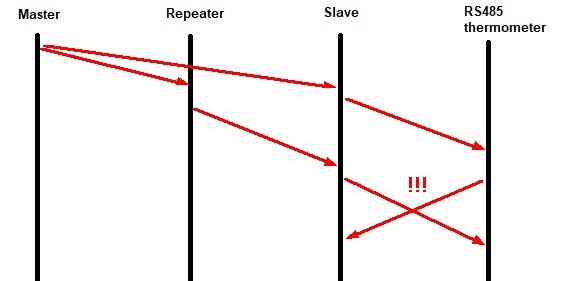 So would this always lead to a collision in communication and the inability to get the right answer?
Yes , it may confliction
That is not a good solution.
The situation could be resolved, for example, if the repeater transmitted the received data using a different ID than the one with which it was received. This would distinguish between slave modules located "behind" the repeater and those communicating directly with the master. Communication would thus be unambiguous, and collisions would be avoided. In other words, the repeater would receive on a single frequency but have two IDs configured; upon receiving data with one ID, it would retransmit it using the other. Couldn't it be handled this way?